Projects




Projects
SENSITIVE CAVE PROTECTION, RESTORATION AND INTERPRETATION
Except as noted, all work detailed below was conducted entirely by volunteers, mostly cavers concerned for the welfare of
the subject caves.
ONGOING
In 2010, the CCC entered into a public/government/conservancy partnership to assist with
cave management and educational programs at Horne Lake Caves Provincial Park on
Vancouver Island, BC. To see the progress on this work, just follow this link:
Horne Lake Caves Project
2024 - Cody Caves Provincial Park, BC - The CCC has provided grants in support of a multi
year cave meteorology monitoring project, including purchase of equipment for the project.
The (expensive) water level recorders needed replacement, and the CCC the funds for their
replacement.
This is the 6th year of year-round climate data logging at 7 sites and the project now has
shown linkage between individual surface storms and underground streamflow
response.
2023 - Cody Caves Provincial Park, BC - The CCC provided grants in support of a multi year
cave meteorology monitoring project, including purchase of equipment for the project.
2018 – Cody Caves Provincial Park, BC - The CCC provided a grant and support to install a
new cave gate and security at Cody Caves Park.
2017 – Cody Caves Provincial Park, BC - The CCC provided funding support for interpretive
signage on a trail built by Friends of West Kootenay Parks and the park operator.
2017 – Speleological Society of Manitoba: The CCC approved funding for a grant supporting a
cave conservation, signage and clean-up project.
2009 – The CCC provided funds for the purchase of concrete to plug an unauthorized entry
into Renaissance Cave. Entry had been gained by digging through a nearby sink, bypassing the
existing gate. The cave has subsequently suffered serious damage. Concrete and metal
reinforcing material were installed in the excavation to plug the illegal entry and protect the
cave from further damage.
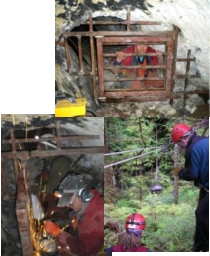
2008 – The CCC provided funds to gate Liquid Sky, a vulnerable cave with fragile speleothems
that was assessed by local cavers to be at risk from vandalism. The funds covered gate
materials & the services of a professional welder; all other work was done by volunteers.
2007 – The CCC provided the funds required to construct and install a new gate on Iron
Curtain Cave, a highly vulnerable cave with delicate speleothems. New locks were also
installed and debris removed from inside the cave. The original gate and lock had been
severely damaged and removed by vandals.
2005 – the CCC and the Ministry of Forests jointly funded the installation of a gate on
Renaissance Cave, a highly decorated and very vulnerable cave located within a very popular
recreational area.
PUBLIC INFORMATION AND AWARENESS
Signage Project
▪
With an expectation that much of the non-industrial damage of caves and karst results
from a lack of information, the Canadian Cave Conservancy has been funding installation
of signage at popular cave sites around Vancouver Island. This effort is continuing.
▪
Science World Display & Demonstration – In 2008 The CCC participated in a display and
demonstration at Science World in Vancouver,
▪
B.C. The goals of this activity were to promote
an interest in caves & caving by the general
▪
public and to gain support for a BC Cave
Protection Act.
INTER-AGENCY LIAISON & INFORMATION SHARING
Vancouver Island Cave Park Planning & Vancouver Island Cave/Karst Strategy
Between 2003 and 2006, with support from the BC Ministry of Water Land & Air
Protection (currently Ministry of Environment) and access to the Ministry of Forests and
Range cave inventory database, the Canadian Cave
Conservancy prepared a Cave/Karst Strategy for
Vancouver Island. The project consolidated existing
inventory information on Island caves and karst, and
compared the recreational and conservation values of
the most significant caves and areas, as well as
presented recommendations for management. It also
prepared draft Interim Management Statements for
Artlish River Caves Park, Weymer Creek Park,
Clayoquot Plateau Park and White Ridge Park.
Review of Commercial Cave Guiding Practice
One of the few uses of caves which generate revenue is the
operation of cave tours. These could range from full-scale
developments with walk-ways and electric lighting to the wild
cave tours more commonly practiced in Canada. Responding to a
need for a review and for cave guiding standards, Mark Hassel
produced an excellent set of recommendations on cave guiding
standards in March 2003. These standards have since been
referenced by Alberta and British Columbia government agencies
when authorizing commercial cave guiding in provincial
jurisdictions. A PDF is available here: Cave Guiding Standards.
Nahanni Karstlands Protection
In 2006, the CCC joined the Canadian Parks & Wilderness Society (CPAWS), Dr. Derek Ford (a leading
Canadian geologist) and many others, calling for an expansion of Nahanni National Park Reserve and
World Heritage Site in order to protect the entire South Nahanni Watershed and the spectacular
limestone features of the Nahanni karstlands.
Langford Lake Cave /Karst Protection
In 2008, the CCC participated in extensive liaison with the City of Langford in an
unsuccessful effort to save this area from disturbance/destruction as a result of a
proposed highway interchange development.
Redemption Cave Baseline
With support from Mountain Equipment Co-op (MEC), a baseline biological survey and
photomonitoring network was established in a newly discovered alpine cave in south-central
British Columbia. A report on the results were forwarded to MEC, and the project leader Kirk
Safford prepared a series of web pages describing the project.
!
Expert Advice
Members of the conservancy have expertise in areas relating to local cave and karst management,
and are often called on for advice. When this evolves into a formal contract with a funding agency, a
portion of the proceeds are routed to support and promote projects by the conservancy.
Donations
The Canadian Cave Conservancy is a fully registered charitable organization under Canadian tax
laws, and any donations are tax-deductible. Contact the CCC at CCC@canadiancaveconservancy.ca
for info.
Funding
The Canadian Cave Conservancy is in a position to consider modest funding requests for cave and
karst conservation in Canada. Ideally, these requests would be multi-partner funding opportunities
where conservancy funding would provide a "seed" for approaching other potential funders. For
more information, send an email to the Canadian Cave Conservancy.


Canadian Cave Conservancy; Last Update 2025 04 04
